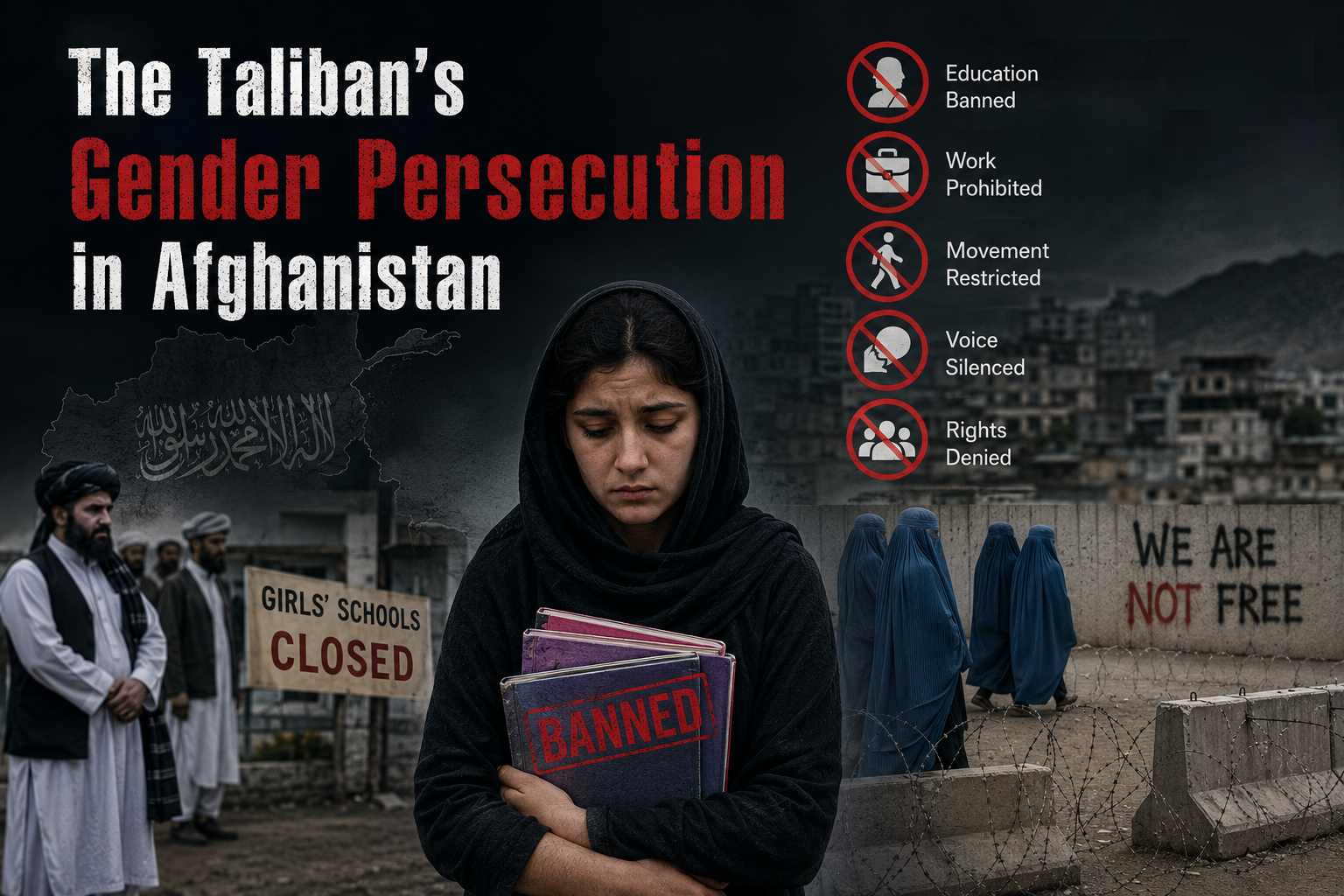
Despite promises made to the international community and the people of Afghanistan, the Taliban’s approach to women’s rights has remained deeply repressive. Since their military takeover on August 15, 2021, they have systematically restricted women’s participation in education, employment, public life, and civil society. Their policies have not only reversed many of the gains Afghan women achieved over the previous two decades, but have also created an institutional system of discrimination that has increasingly been described as gender apartheid.
At the domestic level, women have been pushed almost entirely out of public life, while peaceful protests have been met with intimidation, detention, imprisonment, torture, and forced disappearances. Internationally, the Taliban have imposed measures that are unprecedented in their scope, including barring women from working for the United Nations and international NGOs and restricting education for girls. These measures have challenged both international human rights standards and the principles on which the United Nations was founded.
Yet Afghan women today have not remained silent. Afghanistan’s women’s movement has become one of the strongest forms of civil resistance in the country. Women inside Afghanistan, together with activists in exile and diaspora communities, have continued to demand their basic rights and dignity. Their struggle is not simply a political campaign; it is a defense of their status as equal human beings.
Afghan women’s demands are rooted in a long history. Women gained access to education and suffrage in the early twentieth century. Their progress was repeatedly interrupted by conservative forces, armed conflict, civil war, and the Taliban’s first period in power from 1996 to 2001. Even so, many Afghan governments continued to recognize women’s basic rights, especially in major cities, where women could study, work, and participate in public life.
Between 2001 and 2021, women made major gains with international support and under relatively progressive governments. More than three million girls attended schools and universities. Women served as ministers, judges, legislators, senior civil servants, and governors. They became active in politics, media, education, law, health care, civil society, and business. These achievements were imperfect and often accompanied by discrimination, insecurity, and social pressure, but they nevertheless represented significant progress.
The Taliban’s return now threatens to erase much of that progress. However, Afghan women began resisting almost immediately. On August 17, 2021, only two days after the Taliban entered Kabul, women demonstrated in Kabul and other cities to demand their rights. They did so while many officials were fleeing the country and international forces were focused on evacuation. The Taliban responded with harsh repression, but the protests continued and were amplified by Afghan women abroad.
Over the following years, women activists demonstrated resilience, political maturity, and determination. Many of those leading resistance were not privileged elites but women who had already faced family pressure, workplace discrimination, harassment, insecurity, and misogyny during the previous two decades. Taliban accusations that women’s rights activists are agents of the West do not change the fundamental nature of their demands: education, employment, participation, freedom, and equal dignity.
A strong sense of betrayal also shapes the current struggle. The February 2020 U.S.-Taliban Doha Agreement created expectations that Afghanistan’s political future would include protections for civil society, democratic institutions, and women’s rights. Yet these protections were not made central to the agreement. Afghan women later watched the Taliban return to power while many of the governments that had publicly supported women’s rights withdrew from the country.
For many women, the disappointment was not only about how the Doha agreement was negotiated, but also about the failure of international actors to protect Afghan women during the Taliban’s advance. The collapse took place despite years of international commitments to gender equality and women’s participation. This has contributed to deep distrust among Afghan activists toward governments that speak strongly about women’s rights but fail to translate those commitments into meaningful action.
The international response since 2021 has also been criticised as too narrow and rhetorical. Afghanistan’s human rights crisis is discussed at the United Nations and other multilateral forums, but the Taliban’s restrictions on women are not simply another example of authoritarian abuse or local cultural difference. The Taliban openly reject principles contained in the U.N. Charter, the Universal Declaration of Human Rights, and other international treaties and conventions.
Reports by UNAMA, Amnesty International, and U.N. human rights experts have documented corporal punishment, unlawful killings, collective punishment, repression, and severe restrictions on women and girls. Because independent media and civil society operate under intense pressure and access to information is limited, documented cases may represent only part of the wider situation.
In June 2023, the United Nations Human Rights Council held an Enhanced Interactive Dialogue on the situation of women and girls in Afghanistan. A joint report by the U.N. Special Rapporteur on Afghanistan and the Working Group on discrimination against women described systemic discrimination, oppression, and an institutionalized framework of gender apartheid. This assessment clearly reflects the extraordinary nature of the Taliban’s policies: discrimination is not incidental but built into the system of rule.
The way forward therefore requires more than routine statements of concern. Afghanistan’s women’s movement itself has an important role to play. Activists inside Afghanistan and in exile come from different generations, ethnic groups, linguistic communities, and political backgrounds. Disagreement over methods of resistance is natural, and multiple organizations may emerge. However, divisions should not overshadow the larger objective: ending gender persecution and restoring the fundamental rights of millions of Afghan women and girls.
International civil society and governments can help strengthen cooperation among these groups while ensuring that Afghan women themselves remain central to decision-making. Accountability mechanisms must also be strengthened. The mandate of the U.N. Special Rapporteur on Afghanistan should include stronger gender-responsive investigative capacity to document violations, preserve evidence, and support future accountability.
Muslim-majority countries can play an important role because the Taliban frequently justify restrictions through their interpretation of Islam. Their diplomatic and religious engagement could challenge the claim that denying education and employment to women is an Islamic requirement. However, such engagement should complement rather than replace broader international action.
Education must also remain an urgent priority. With girls excluded from many schools and universities, large-scale online education initiatives could provide alternative learning opportunities. Afghan education experts in exile could help oversee curricula, quality, and accreditation. Such measures should not relieve the Taliban of responsibility for reopening schools and universities, but they could reduce the long-term damage being done to a generation of young people.
The situation in Afghanistan presents a major test for the international human rights system. The Taliban’s policies threaten not only Afghan women but also the credibility of global commitments to dignity, freedom, justice, and equality. Afghan women have continued to resist under extraordinary pressure. Their movement now has an opportunity to become more coordinated, cohesive, and influential. But their efforts require meaningful international support, stronger accountability, and sustained pressure.
The rights of Afghan women and girls cannot be treated as a secondary issue or postponed for political convenience. The longer the current restrictions continue, the deeper their social, economic, and human consequences will become. Ending gender persecution, restoring access to education and work, and protecting women’s full participation in society must remain central to any serious approach to Afghanistan’s future.